

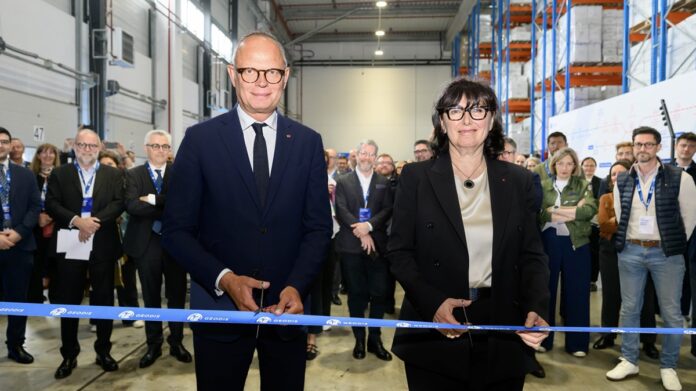
Global logistics provider GEODIS has announced the official establishment of its first integrated port hub in France, positioned inside the Port of Le Havre. The centralized maritime gateway facility is engineered to provide international shippers with a comprehensive, end-to-end operational footprint to streamline European import-export flows.
As France’s largest container gateway, the Port of Le Havre serves as a primary conduit for French foreign trade, having handled more than 3.2 million containers in 2025 with active liner connections to over 700 ports worldwide.
Consolidating Four Core Business Lines at a Single Site
The primary structural innovation of the Le Havre hub is the physical co-location of GEODIS’ four primary corporate operational divisions within a unified terminal footprint. By breaking down traditional siloed logistics structures, the site enables cross-functional cargo management under a single management team.
The hub integrates the following core capabilities:
- International Freight Forwarding: Managing end-to-end deep-sea ocean freight, specialized air cargo routing, intermodal rail logistics, and on-site customs brokerage clearance.
- Contract Logistics: Providing dedicated container stripping, cross-docking, specialized product sorting, inventory management, and purchase order fulfillment.
- European Road Transport: Organizing full-truckload (FTL) and less-than-truckload (LTL) linehaul distribution to major manufacturing and consumer markets across mainland Europe.
- Distribution & Express Delivery: Facilitating rapid final-mile parcel delivery and just-in-time regional retail replenishment.
Eliminating Supply Chain Disruption and Handling Bottlenecks
By routing import and export shipments through a single, multi-service facility directly inside the port zone, GEODIS removes several layers of secondary handling, domestic shunting, and external administrative friction. Containers can be pulled directly from the marine terminals, stripped on-site, cross-docked into the road network, or cleared through customs without leaving the centralized hub.
This operational proximity significantly reduces cargo dwell times and minimizes transit damage risks associated with secondary off-site transport. Additionally, the integrated model gives supply chain managers a single point of accountability and real-time data visibility over their cargo, providing the structural flexibility required to adapt to changing global maritime schedules and unpredictable port terminal delays.
อัพเดตข่าวสารและบทความที่น่าสนใจในอุตสาหกรรมโลจิสติกส์ก่อนใคร ผ่าน Line Official Account @Logistics Mananger เพียงเพิ่มเราเป็นเพื่อน @Logistics Manager หรือคลิกที่นี่