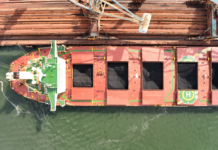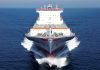


Global shipping company Kawasaki Kisen Kaisha, Ltd. (“K” LINE) has signed shipbuilding contracts with China Merchants Jinling Shipyard (Nanjing) Co., Ltd. for the construction of four 1,380-vehicle capacity Pure Car and Truck Carriers (PCTCs). The newbuilds will be deployed by “K” LINE’s wholly owned European subsidiary, “K” Line European Sea Highway Services GmbH (KESS), to modernize its regional short-sea distribution network.
The specialized vessels are custom-engineered to navigate the unique infrastructural limits of European automotive ports, providing a flexible intra-European shipping alternative for manufacturers moving vehicles and heavy machinery across northern and southern European trade lanes.
Custom Specifications for Constrained European Ports
Unlike standard ocean-going car carriers built for intercontinental trade, this four-vessel series is scaled specifically for high-frequency short-sea voyages and small-lot cargo distribution. The hull dimensions and draft parameters are designed to comply with strict physical size restrictions common among European imported car terminals, allowing KESS to access shallow-draft inner ports and older coastal facilities that cannot accommodate larger vessels.
To broaden its market utility beyond standard passenger cars, the carrier has equipped the vessels with robust cargo-handling hardware:
- Heavy-Duty Ramps: Each vessel features a straight stern ramp with a maximum structural load capacity of 60 tons.
- High and Heavy Flexibility: The heavy-duty ramp rating allows KESS to safely load industrial farm equipment, oversized construction vehicles, and heavy project cargo alongside factory-new passenger cars.
- Frequent Lot Operations: The deck layouts are configured to optimize rapid roll-on/roll-off (RoRo) discharging and reloading sequences, cutting down on port turnaround times across multi-stop European itineraries.
Advanced Propulsion Engineering to Mitigate Methane Slip
The new vessels utilize a high-pressure ME-GI dual-fuel engine coupled with a shaft generator system. In standard low-pressure LNG ship designs, a small percentage of unburned natural gas can escape into the atmosphere through the exhaust—a phenomenon known as methane slip. The high-pressure ME-GI system significantly reduces this effect by ensuring more complete combustion within the engine cylinders.
Furthermore, the vessels address the challenge of boil-off gas (BOG), which occurs when heat penetrates LNG fuel tanks and causes a portion of the liquefied gas to evaporate. To minimize BOG generation, the ships are built with high-efficiency vacuum-insulated LNG storage tanks. This layout maintains ultra-low internal temperatures, lowering the overall volume of evaporated gas and optimizing fuel retention during extended port stays.
Advancing the Environmental Vision 2050 Mandate
Transitioning from conventional heavy fuel oil (HFO) to a liquefied natural gas propulsion system delivers immediate local and global environmental benefits. The dual-fuel configuration is projected to cut carbon dioxide (CO2) emissions by 25% to 30%, while reducing sulfur oxides (SOx)—a primary cause of regional marine air pollution—by nearly 100%.
The investment serves as a tactical component of the group’s long-term corporate sustainability framework, “K” LINE Environmental Vision 2050: Blue Seas for the Future, which mandates a goal of net-zero greenhouse gas emissions by 2050. To advance beyond baseline fossil LNG parameters, the company is actively preparing to integrate drop-in renewable fuels, including bio-diesel, bio-LNG, and liquefied biomethane, as commercial production scales across the European maritime supply chain.
อัพเดตข่าวสารและบทความที่น่าสนใจในอุตสาหกรรมโลจิสติกส์ก่อนใคร ผ่าน Line Official Account @Logistics Mananger เพียงเพิ่มเราเป็นเพื่อน @Logistics Manager หรือคลิกที่นี่