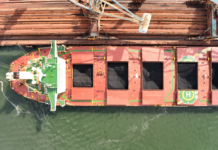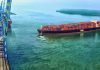

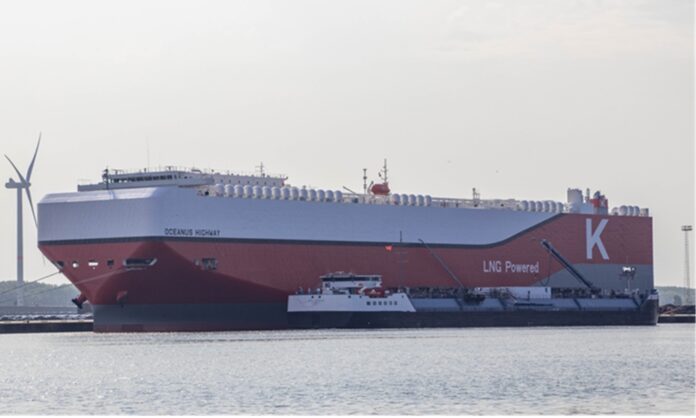
Kawasaki Kisen Kaisha, Ltd. (“K” LINE) has announced the successful completion of its first-ever use of Bio-LNG fuel for a car carrier. On June 16, the vessel OCEANUS HIGHWAY received 500 tons of the renewable fuel from Shell Western LNG B.V. at the Port of Zeebrugge, Belgium.
This marks a significant step in “K” LINE’s long-term environmental strategy to achieve net-zero greenhouse gas (GHG) emissions by 2050.
A Carbon-Negative “Drop-in” Solution
The Bio-LNG fuel, also known as liquefied bio-methane (LBM), is derived from renewable organic waste and residue. It is certified by the International Sustainability and Carbon Certification (ISCC-EU), confirming its carbon intensity is less than zero on a lifecycle basis, from production to consumption.
As a “drop-in” solution, Bio-LNG is fully compatible with existing LNG infrastructure and dual-fuel engines, making it a viable and scalable option for the decarbonization of the shipping industry. According to Dexter Belmar, Vice President of Shell Downstream LNG, this collaboration with “K” LINE is a key part of building momentum for the industry’s transition to renewable fuels.
Supporting Net-Zero Targets
The use of Bio-LNG is a crucial component of “K” LINE’s Environmental Vision 2050: Blue Seas for the Future. The company has set an ambitious interim target for 2030 to improve its CO2 emission efficiency by 50% from 2008 levels, surpassing the International Maritime Organization’s (IMO) target of a 40% improvement.
Hiroto Arai, General Manager of the “K” LINE Environmental/Technical Strategy Group, stated that the partnership with Shell positions the company to play a substantial role in the industry’s transition. He affirmed “K” LINE’s continued commitment to introducing low-environmental-impact fuels to meet its 2050 net-zero goal.
อัพเดตข่าวสารและบทความที่น่าสนใจในอุตสาหกรรมโลจิสติกส์ก่อนใคร ผ่าน Line Official Account @Logistics Mananger เพียงเพิ่มเราเป็นเพื่อน @Logistics Manager หรือคลิกที่นี่