



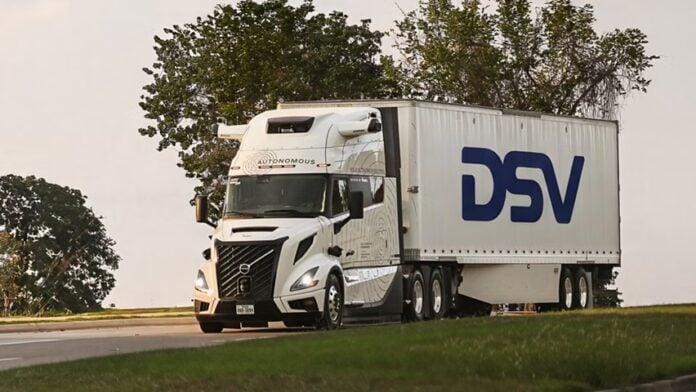
Volvo Autonomous Solutions (V.A.S.) and global transport and logistics provider DSV have officially initiated commercial autonomous freight operations in Texas. The milestone deployment marked its first revenue-generating cargo haul utilizing the purpose-built Volvo VNL Autonomous truck, establishing a foundation for scalable, self-driving fleet integration across North American logistics networks.
The hub-to-hub freight runs operate directly between designated Aurora terminals in Dallas and Houston, fully absorbing the autonomous lanes into DSV’s existing regional distribution flows.
Purpose-Built Hardware Integrated with the Aurora Driver
The flagship vehicle utilized in the rollout is the Volvo VNL Autonomous, a Class 8 semi-truck engineered from the ground up for production-level self-driving applications. Rather than using aftermarket retrofits, the truck features factory-integrated redundantly engineered steering, braking, and power management systems to guarantee safety-critical backups.
The vehicle’s primary digital guidance system is the Aurora Driver, an advanced suite of software and hardware combining long-range lidar, radar, and high-definition cameras. This sensory array allows the vehicle to safely navigate complex, high-density interstate traffic. To maintain strict alignment with Volvo’s structured safety frameworks during this initial launch phase, a professional safety driver remains behind the wheel to monitor system behaviors and retain override authority.
Maximizing Asset Utilization via a Production-Level Ecosystem
To support commercial operations at scale, V.A.S. is deploying its comprehensive Autona/freight program for DSV. This end-to-end transport ecosystem bundles the specialized autonomous trucks with self-driving technologies from strategic partners like Aurora and Waabi, while layering in the cloud-based dispatching routing, terminal management tools, and specialized maintenance infrastructure needed to support driverless operations.
Helmut Schweighofer, CEO of DSV Road, stated that autonomous driving is rapidly moving toward real-world operations. He explained that the collaboration with Volvo in Texas represents a production-level, depot-to-depot setup that presents clear opportunities to improve safety and driver comfort, mitigate a growing regional driver shortage, and unlock superior asset utilization through 24/7 operations for the benefit of their customers.
Sasko Cuklev, Head of On-Road Solutions at V.A.S., noted that logistics providers like DSV represent an essential customer group for Volvo Autonomous Solutions, with DSV at the forefront of applying self-driving transport within real-world networks. He affirmed that starting between Dallas and Houston, the partners plan to move commercial freight in a manner that supports round-the-clock operations and builds a scalable foundation for adding more lanes over time.
Capitalizing on Real-World Operational Experience
The Texas hub-to-hub deployment leverages deep operational experience. Since 2023, V.A.S. has logged more than one million miles across regional and local freight pilots. This continuous data collection helps refine machine learning models and route planning strategies, giving both companies the technical confidence to scale up the volume of autonomous shipments.
By converting the high-density Dallas-to-Houston corridor into an active autonomous proving ground, Volvo and DSV aim to demonstrate how self-driving heavy trucks can reduce transit variability, lower fuel burn through optimized highway speed profiles, and provide a repeatable framework for expanding autonomous transport throughout the wider United States Midwest and Southwest logistics markets.
อัพเดตข่าวสารและบทความที่น่าสนใจในอุตสาหกรรมโลจิสติกส์ก่อนใคร ผ่าน Line Official Account @Logistics Mananger เพียงเพิ่มเราเป็นเพื่อน @Logistics Manager หรือคลิกที่นี่