

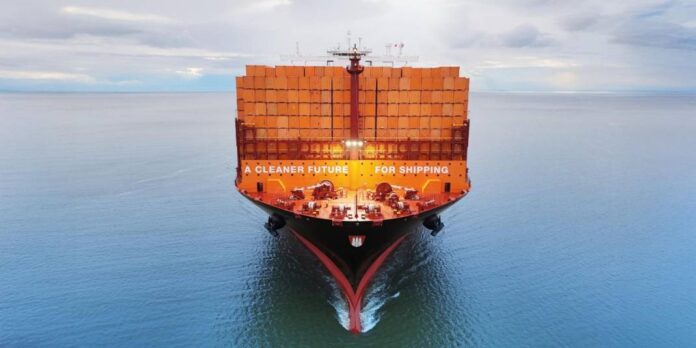
Liner shipping company Hapag-Lloyd and global logistics provider Kuehne+Nagel have finalized their first joint commercial agreement to deploy Sustainable Marine Fuels (SMF) across high-volume ocean freight lanes. The allocation contract sets a structured carbon reduction target for the remainder of the 2026 shipping year, introducing scalable low-emission transport options for international retail and industrial shippers.
The deployment spans an operational window from April through December 2026, systematically integrating eco-friendly alternative fuels into the carriers’ shared transshipment volumes.
Operational Scope and Fuel Compliance Standards
Under the terms of the agreement, Kuehne+Nagel will utilize Hapag-Lloyd’s proprietary “Ship Green” sustainability product to systematically reduce the Scope 3 value chain emissions generated by its clients’ cargo. The program covers an estimated volume of 3,300 TEUs of ocean container freight moving along the vital East Asia-to-North Europe trade lane.
The decarbonization program relies on the consumption of approximately 1,000 tonnes of certified, waste- and residue-based liquid biofuels. The fuel blends comply strictly with the European Union’s updated RED III (Renewable Energy Directive) criteria, ensuring the source materials do not compete with food crops or drive regional deforestation.
On a comprehensive “well-to-wake” accounting basis—which tracks emissions from raw material extraction through final maritime propulsion—the initiative is projected to avoid exactly 2,979 tonnes of carbon dioxide equivalent (CO2e) emissions compared to conventional heavy fuel oil (HFO).
Scaling Decarbonization via Book-and-Claim Accounting
To bypass the operational bottlenecks of physical fuel allocation on specific ocean liners, the partnership operates via a verified book-and-claim chain-of-custody mechanism. This industrial accounting practice allows Kuehne+Nagel to claim verified carbon emission reductions for its clients even if a specific container is loaded onto a conventional vessel.
The environmental attributes are mathematically mapped to the logistics provider based on the verified volume of waste-based biofuel physically pumped into Hapag-Lloyd’s active fleet bunkering networks. This flexible framework creates a scalable, market-based approach that rewards alternative fuel production without requiring separate, fractured green supply chains for individual vessels.
Driving Toward Mid-Century Net-Zero Targets
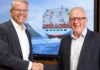
Danny Smolders, Managing Director of Global Sales at Hapag-Lloyd, stated that the Ship Green product offers a scalable solution that allows customers to actively cut their Scope 3 emissions. He emphasized that the agreement demonstrates how strong partnerships can translate directly into tangible climate impact.
Paolo Montrone, Head of Trade Global Sea Logistics at Kuehne+Nagel, added that decarbonizing global shipping requires transparency, collaboration, and commercially viable solutions. He noted that enabling transparent data and verified scope 3 reductions helps customers navigate the market in a credible way designed to accelerate the broader industrial uptake of alternative fuels.
The joint environmental rollout directly supports the individual sustainability roadmaps of both logistics corporations:
- Hapag-Lloyd has committed to reaching absolute net-zero fleet operations by 2045.
- Kuehne+Nagel maintains a binding corporate target to achieve net-zero greenhouse gas emissions across its entire global supply chain value network by 2050.
By combining commercial cargo volumes with verified biofuel offtake agreements, the companies aim to stimulate long-term infrastructure investment in sustainable maritime fuel production, driving down the green cost premium for international shippers.
อัพเดตข่าวสารและบทความที่น่าสนใจในอุตสาหกรรมโลจิสติกส์ก่อนใคร ผ่าน Line Official Account @Logistics Mananger เพียงเพิ่มเราเป็นเพื่อน @Logistics Manager หรือคลิกที่นี่